

TURNBRIDGE ARCHIVE
A survivor-led archive of firsthand accounts, public records, review patterns, and staff-vetting concerns.
Before sending someone to Turnbridge, ask for written answers to these five questions:
1. How are sexual-boundary complaints documented?
2. Can families review incident reports?
3. What happens after client-on-client violence?
4. What background checks are used for staff?
5. Has any staff member been rehired after client-safety complaints?
EVIDENCE

This database preserves specific accounts, public-source materials, review patterns, and records-preservation questions concerning client safety, staff response, supervision, and institutional accountability.

Statement of Intent
This archive is a survivor-led due-diligence record concerning my experience, public-source materials, public reviews, and records-preservation questions. I am documenting accounts and patterns involving client-on-client violence, staff conduct, staff-vetting concerns, sexual-boundary complaints, peer culture, and institutional response. This is not a legal filing, clinical record, regulatory finding, or final factual determination. It is a preservation record and a request for documentation before more evidence disappears.
ARCHIVE SUMMARY
"I remember watching staff laugh while reviewing the CCTV footage of a client being assaulted. It wasn't just a failure of safety; it was a culture of mockery."
Institutional Patterns


Client Safety Questions
Sexual-Boundary Complaints and Staff Response
Staff Vetting / Staff-Response Questions
My Turnbridge / Turning Point experience raised serious questions about client safety, supervision, incident documentation, and staff response to violence.
During my time there, I personally witnessed or experienced multiple client-safety concerns: staff allegedly replaying CCTV footage after an incident in which M.J. chased C.S., sprayed C.S. with a fire extinguisher, and attempted to beat him with the extinguisher; a late-2021 violent chair assault at 90 Ford Street that was allegedly captured on camera; threats of bodily assault that I do not believe were meaningfully addressed; and a later concern that a frightened younger client was returned to shared housing with someone he said had restrained and beaten him.
The archive also preserves a serious E.J. / D.A. sexual-privacy incident lead from early 2022. E.J. is not the former client’s actual initials; I am using protective pseudonymous initials at his request. E.J. later disclosed that D.A. allegedly filmed him naked / masturbating and texted the video to multiple people. E.J. stated that Turnbridge staff knew the details, that staff were complicit, and that D.A. was downgraded to Phase 1 when police probably should have been involved. I personally remember seeing the video circulating at the time. I am not presenting this as a verified finding, but it belongs in the client-safety record because it raises serious questions about sexual privacy, staff knowledge, documentation, police involvement, evidence preservation, and protection after disclosure.
I also preserve a secondhand allegation that Douglas Roberto left a Phase III house unsecured, that a masked intruder entered, and that a client was allegedly asked to help sweep the house rather than staff following a clear safety protocol. I did not witness that incident, but I heard it from multiple people and believe it belongs in the record as a serious safety lead requiring corroboration.
Public reviews from families and former clients raise similar concerns. Several reviewers allege poor supervision, unsafe conditions, inadequate monitoring, self-harm risk, weapons or drugs allegedly entering the facility, and families feeling misled by Turnbridge’s public image.
The core question for families is simple: How does Turnbridge document violence, review CCTV, protect clients after threats, assaults, sexual-safety incidents, or nonconsensual intimate recording, control contraband, respond to self-harm risk, and prove that incident reports lead to action?
My experience raised serious concerns about sexual-boundary complaints, outing threats, harassment, coercion, unsafe outside contact, sexual privacy, and staff response.
At 1212 Quinnipiac Avenue in late 2022, I told E.O. that L.M. had crossed a serious sexual boundary with me and would not stop when I wanted him to. Mark Grasso overheard me relay this. His response, as I remember it, was that it sounded crazy and that I could report it to higher-ups if I felt like it. To my knowledge, no meaningful protective action followed, and L.M. continued harassing me afterward.
Around November 2022, during a Phase II weekly movie trip to see Nope, E. and I had a sexual-boundary incident during the movie. Afterward, back at 520 Whitney Avenue, I told M.S. what had happened. M.S. allegedly threatened to tell everyone I was gay unless I Venmoed him $50. I felt physically imposed on and threatened, and I sent the money. When I later disclosed this to Douglas Roberto, another case manager was also present. Douglas responded, “Why would you send him $50?” To my knowledge, no meaningful action followed, and M.S. continued harassing and threatening me through social media.
The archive also preserves a serious E.J. / D.A. sexual-privacy incident lead from early 2022. E.J. is not the former client’s actual initials; I am using protective pseudonymous initials at his request. E.J. later disclosed that D.A. allegedly filmed him naked / masturbating and texted the video to multiple people. E.J. stated that Turnbridge staff knew the details, that staff were complicit, and that D.A. was downgraded to Phase 1 when police probably should have been involved. I personally remember seeing the video circulating at the time. I am not presenting this as a verified finding, but it belongs in the record because it raises serious questions about sexual privacy, staff knowledge, documentation, police involvement, evidence preservation, and protection after disclosure.
Public reviews raise similar sexual-safety and supervision concerns. One parent / loved-one review alleges that a child at Turnbridge was permitted to maintain unsafe outside contact with a person connected to prior sexual harm, despite family concern, and that the child was later sexually assaulted while at Turnbridge. I am not presenting that review as a verified finding, but it belongs in the record because it echoes the same institutional questions: supervision, sexual-safety protocols, outside-contact boundaries, family communication, documentation, and protection after disclosure.
The archive also preserves secondhand sexual-boundary concerns involving staff and clients, including an allegation involving Liam and an underage former client, and a reported Steve Tobey / C.R. concern involving sexualized staff self-disclosure and pressure around client sexuality.
The core question for families is: What happens when a client reports a sexual-boundary complaint, outing threat, coercion, harassment, unsafe outside contact, nonconsensual intimate recording, or sexualized staff behavior? Who documents it? Who protects the reporting client? Can families see the incident records?
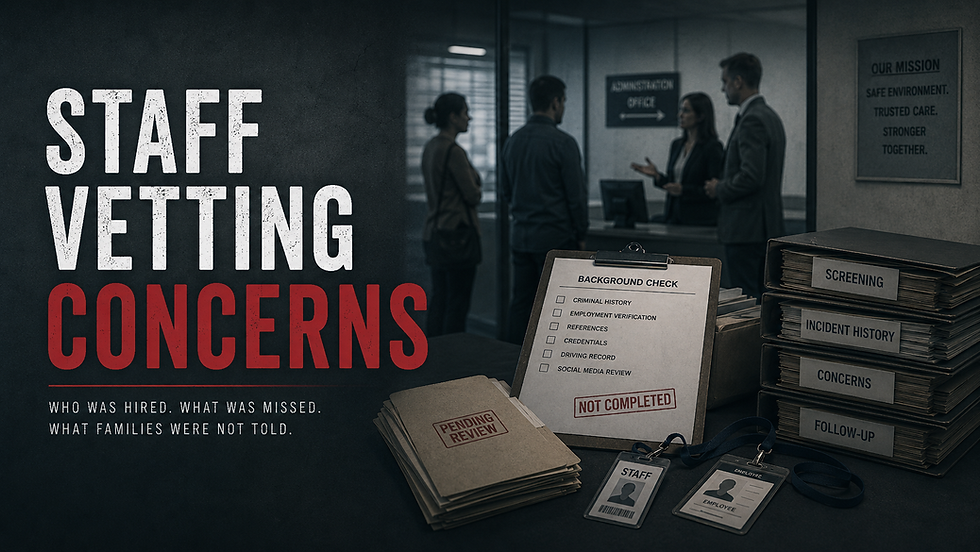
My account raises questions about how Turnbridge vetted, supervised, retained, and assigned case managers and support staff who had direct authority over vulnerable clients. Public-source concerns include arrest / charge reporting, licensing or credential records, and allegations or recollections involving staff conduct, rehiring, transportation, and client-safety response.
My own experience also involved staff conduct that I believe families should ask about: staff allegedly replaying and mocking CCTV footage of client violence, staff allegedly using shame-based or ideological pressure with clients, staff allegedly handling transportation in concerning ways, and case managers allegedly responding dismissively after serious disclosures.
The question for families is not whether every allegation can be proven from memory alone. The question is whether Turnbridge can produce records showing clear standards for background checks, staff supervision, credential review, incident reporting, transportation safeguards, rehiring decisions, and client-safety accountability.
“The archive raises a records question: what was reported, who knew, what was documented, and what action followed?”
Connecticut DPH Has Opened an Investigation Into Turnbridge
Former clients, families, staff, and witnesses can now submit relevant information directly to state investigators.
On July 10, 2026, the Connecticut Department of Public Health confirmed that its Facility Licensing & Investigations Section opened an investigation into care and services provided by Turnbridge.
If you experienced, witnessed, reported, or documented concerns involving Turnbridge—including client safety, violence, sexual-boundary violations, medication access, supervision, admissions representations, program length, barriers to leaving, confidentiality, staff conduct, or complaint handling—this is an important time to preserve and submit your information.
When contacting DPH, reference:
Complaint #CT00046663
Connecticut Department of Public Health
Facility Licensing & Investigations Section
Phone: (860) 509-7400
People may also contact the archive at: sb6560@nyu.edu
NOW IS THE TIME TO COME FORWARD
If you have relevant information, preserve your records and contact DPH. Reference Complaint #CT00046663 so investigators understand that your information may relate to the existing Turnbridge investigation.
This website is independently operated by a former Turnbridge client and is not affiliated with the Connecticut Department of Public Health. The opening of an investigation is not itself a final finding. All allegations should be presented accurately and identified as firsthand, secondhand, or unverified where appropriate.
Share an Anonymous Turnbridge / Turning Point Testimony
This is a safe, trauma-informed space to document your experiences. Your testimony helps build a community record of transparency and safety. All identifying information is optional, and your submission will be handled with the highest degree of sensitivity.
You can skip any question that doesn’t feel safe to answer.
Your IP address is not recorded by this form. All identifying information is optional and will be handled with discretion if provided.
Video Testimony / Archive Context
This video expands on the institutional patterns described above and explains why this archive was created. It should be understood as survivor testimony and archive context, not as a final legal finding. All allegations should be independently reviewed and verified.
Search Terms
A comprehensive list of keywords and phrases designed to ensure institutional transparency and survivor-led documentation.
Turnbridge abuse •
Turnbridge client safety•
Turnbridge Reddit •
Turnbridge complaints •
Turnbridge Connecticut •
Public Record / Staff-Vetting Notes
These entries are preserved as public-source and staff-vetting questions, not as final findings of unfitness. Arrests and charges are not convictions. Same-name or partial-name matches require identity confirmation. Licensing records should be described only according to what the licensing source actually shows.
Peter McConnell: Public-indexed police results surfaced a possible arrest / charge trail involving Harassment 2nd Degree and Threatening 2nd Degree in 2017. Identity, docket, and final disposition should be confirmed before stronger public use.
Dayton Kingery: Public reporting and widely circulated video identified Dayton Kingery as having been arrested and charged in California with felony vandalism, resisting arrest, making criminal threats, and elder-abuse-related conduct before later Turnbridge employment. This should be described as arrest / charge history only, not conviction language unless final court disposition is verified.
Kelly Mccormack: Connecticut Judicial Branch records identify Kelly Elizabeth McCormack, birth year 1984, with multiple criminal convictions before or during the period relevant to her later Turnbridge employment. Official court records show guilty findings for sixth-degree larceny in 2017 and 2019, second-degree breach of peace and second-degree threatening in 2019, and violation of probation in 2020. The 2017 larceny case resulted in an unconditional discharge; the 2019 larceny case resulted in a suspended 90-day jail sentence and one year of probation; the breach-of-peace and threatening case resulted in suspended jail sentences and two years of probation.
A 2012 Connecticut news report separately described a Kelly McCormack, then age 27, as charged with disorderly conduct after a dispute over personal property. Former Turnbridge client I.S.C. identifies McCormack as her case manager and alleges repeated screaming, humiliation, invasive searches, prolonged restrictions, favoritism, gossip, planted marijuana, a planted or allegedly found condom, an approximately eight-week Phase 1 regression, and the taking or non-return of her Nintendo Switch. I.S.C. also alleges McCormack later left Turnbridge after refusing a drug test requested by the program. These latter claims remain direct-source allegations requiring HR, complaint, property, drug-testing, and case-management records. Staff-vetting question: what did Turnbridge know, what background screening was performed, and why was McCormack given authority over vulnerable clients, their property, privileges, schedules, and phase progression?
Mason Edwards:
A former Turnbridge client publicly identified Mason Edwards as a Turnbridge staff member and alleged that he was reported numerous times for inappropriate interactions with clients, often minors. A LinkedIn profile under the name Mason Edwards lists Turnbridge employment beginning in June 2017, although the displayed “Present” end date may be outdated. A publicly circulated predator-confrontation video appears to show a man identified as Edwards acknowledging alleged communications and plans involving someone presented as fourteen years old and repeatedly asking for forgiveness. His exact Turnbridge role, work locations, employment end date, identity in the video, and Turnbridge’s knowledge or response require further verification.
Turnbridge survivor •
Turnbridge bad reviews •
Turnbridge staff vetting •
Turnbridge residential treatment •
Turnbridge New Haven •
Political / ideological boundary concerns•
Mark David Grasso / Mark Grasso: Public materials identify a Mark Grasso of Bridgeport as a Family ReEntry recovery coach and quote him saying addiction “landed me in prison” before he turned his life around. A public Instagram profile using the handle @markdgrassoct22 and display name “Mark David Grasso” appears consistent with the Turnbridge staff member I remember as Mark Grasso at 1212 Quinnipiac, though employment records / staff rosters should confirm identity before stronger claims are made. Do not state specific charge, docket, conviction, or disposition details unless official records are located and verified.
Ian Parker:
Public reporting from WestportNow and Patch described an Ian Parker, age 25, of Westport, arrested on December 16, 2016 and charged with second-degree assault and disorderly conduct after police found a male party bleeding from the head; the same reporting also referenced a prior narcotics/paraphernalia arrest and an outstanding failure-to-appear warrant. A later public recovery testimonial provides identity anchors connecting the Westport Ian Parker profile to later long-term-treatment case-management work. Final court disposition should be verified before stronger use.
Chris Meyer: Public police-log reporting named Christopher William Meyer, age 35, of Ford Street, Hamden, and listed charges including second-degree breach of peace, first-degree stalking, second-degree harassment, and voyeurism with malice. Turnbridge publicly identified Chris Meyer as Phase I support staff in “Unsung Hero” material; arrest or charge language should not be described as conviction language unless final court disposition is verified.
Thomas Marzili / Tom Marzilli:
Turnbridge publicly identified Tom Marzilli as Executive Director of Residential Services and as a senior leader connected to its men’s and adolescent residential programs. A., a former client of Turnbridge’s women’s program, identifies him as a program director in the women’s-program environment during 2017.
A. alleges that Marzilli used graphic and sexualized language while questioning a seventeen-year-old client about a sexual encounter with a man she met at a recovery meeting. According to A., Marzilli screamed at the minor and asked whether the man had “came inside her.” A. has said she will ask the former client whether she is willing to provide her own account.
This allegation raises serious questions about the sexualized interrogation of a minor, the use of staff authority, trauma-informed interviewing, confidentiality, medical and pregnancy-related safety, mandated reporting, and whether the interaction was documented or supervised.
A. separately alleges that Marzilli became sexually involved with a woman who had recently graduated from Turnbridge and then became support staff. According to A., Marzilli was subsequently barred from the women’s house because of that relationship.
The archive author independently recalls hearing while enrolled at Turnbridge that Marzilli had been banned from the women’s house. That recollection supports the narrower point that a restriction involving the women’s residence was discussed within Turnbridge. It does not independently prove why the restriction was imposed. A. is presently the direct source connecting the alleged restriction to sexual involvement with a recently graduated former client who became staff.
Colorado licensing materials identify Thomas Paul Marzilli as an “Unlicensed Psychotherapist” and record a voluntary surrender or relinquishment of his credential effective May 23, 2016, under case number 2015-1632. The final agency order states that the Colorado Board formally alleged violations of former Colorado Revised Statutes § 12-43-222(1)(f)(I), (g)(I), (i), (p), and (r).
The supplied statutory materials establish that the alleged violations included:
-
§ 12-43-222(1)(g)(I): failing to meet generally accepted professional standards;
-
§ 12-43-222(1)(p): failing to provide legally required disclosures to clients under § 12-43-214; and
-
§ 12-43-222(1)(r): engaging in sexual contact, sexual intrusion, or sexual penetration with a client during the therapeutic relationship or within two years after the relationship ended.
The mandatory client-disclosure requirements referenced in subsection (p) concerned matters including the professional’s treatment methods, anticipated duration of treatment, fees, the client’s right to terminate treatment, confidentiality, and the rule that sexual intimacy within a professional relationship is never appropriate.
The final order also listed subsections § 12-43-222(1)(f)(I) and § 12-43-222(1)(i). The materials currently preserved in the archive identify those subsections as part of the Board’s formal allegations, but the archive has not yet obtained or independently verified the complete historical statutory language necessary to summarize those two provisions accurately. They should remain listed by subsection rather than assigned a guessed description.
This is not merely a record showing an unexplained voluntary surrender. It is an official agency order showing that Colorado regulators formally accused Marzilli of several categories of professional misconduct, including substandard professional practice, failure to give required disclosures to clients, and conduct falling within a statutory provision addressing sexual contact with a client during therapy or within two years afterward. Marzilli denied the allegations and surrendered the credential instead of proceeding through a contested hearing.
That distinction is legally important. The archive should not claim that every allegation was proven after a hearing. It can accurately state that the Board formally brought these allegations, that one allegation category specifically concerned sexual contact or intrusion involving a client, that Marzilli denied the allegations, and that the proceeding ended in the voluntary surrender or relinquishment of his credential.
A. also alleges that Marzilli had a compulsive gambling problem and named a Turnbridge softball team “Minus 160,” a reference to betting odds. She supplied a photograph appearing to show Marzilli wearing a red Turnbridge jersey bearing that name. The photograph supports the narrower fact that the “Minus 160” name was used; it does not independently establish compulsive gambling.
A separate public Foxwoods Poker post dated February 13, 2016, identified Thomas Marzilli as the chip leader in Event No. 12, Flight A, with 265,100 chips. That record confirms his public participation in poker and provides context for A.’s account, but does not by itself prove a gambling disorder.
The combined record presents a serious leadership-vetting issue. Turnbridge placed Marzilli in senior authority over vulnerable adolescents and young adults after Colorado regulators had formally alleged multiple categories of professional misconduct—including a statutory sexual-contact category—and after he surrendered the credential. A former women’s-program client now separately alleges sexualized treatment of a seventeen-year-old and an improper sexual relationship with a recent graduate who became staff.
Turnbridge should be required to explain whether it knew about the Colorado case, whether it obtained the complete complaint and disciplinary file, how it evaluated the sexual-contact and mandatory-disclosure allegations, what Marzilli disclosed during hiring and promotion, whether he was restricted from women’s facilities, why any restriction was imposed, what internal complaints or investigations existed, and why he remained or advanced in senior residential leadership.
The archive is seeking the complete Colorado DORA credential and disciplinary file, including the complaint, stipulation, final order, investigative materials, and historical statutory provisions, along with Turnbridge’s background checks, employment applications, credential verifications, promotion reviews, complaints, supervision files, access restrictions, house assignments, internal communications, and testimony from additional former clients and staff.
Turning Point abuse •
Turnbridge supervision failures •
Turnbridge troubled teen industry •
Turnbridge rehab •
Concerns about returning clients •
Sexual-Boundary Complaints, Coercion, and Staff-Response Questions
Archival material collected so far includes my firsthand account, direct former-client disclosure, secondhand / overheard allegations, public-record notes, public review patterns, Rehabs.com reviews, Reddit survivor testimony, and corroboration leads concerning sexual-boundary complaints, coercion, outing threats, harassment, sexual privacy, physical violence, emotional harm, and staff-response concerns at Turnbridge / Turning Point.
These accounts are not presented as a single proven legal finding. They are preserved because they raise serious due-diligence questions about whether staff, case managers, and management responded appropriately when vulnerable clients disclosed sexual-boundary complaints, threats, coercion, violence, fear of retaliation, emotional harm, or nonconsensual intimate recording / distribution.
The archive includes my firsthand account of a sexual-boundary disclosure allegedly overheard by staff without meaningful follow-up; a Phase II movie-trip incident followed by alleged Venmo coercion / outing threats; later harassment after disclosure; and the E.J. / D.A. sexual-privacy incident lead. E.J. is not the former client’s actual initials; I am using protective pseudonymous initials at his request. E.J. later disclosed that D.A. allegedly filmed him naked / masturbating and texted the video to multiple people. E.J. stated that Turnbridge staff knew the details, that staff were complicit, and that D.A. was downgraded to Phase 1 when police probably should have been involved. I personally remember seeing the video circulating at the time. I am not presenting this as a verified finding, but it raises serious questions about sexual privacy, staff knowledge, documentation, police involvement, evidence preservation, and protection after disclosure.
The archive also preserves secondhand allegations involving sexualized staff self-disclosure and inappropriate pressure toward a client.
Public Rehabs.com material is relevant because it includes loved-one and former-client reviews raising similar concerns about supervision, complaint handling, and sexual safety. One loved-one review alleges unsafe outside contact involving a minor client and a person connected to prior sexual harm, and further alleges sexual assault by another patient. This is preserved as a public-review allegation, not as a verified finding.
Reddit survivor and parent accounts also raise related concerns about violence, homophobia, coercive retention pressure, emotional abuse, and complaint-handling. These materials are included as public discourse and survivor / family testimony, not as court findings.